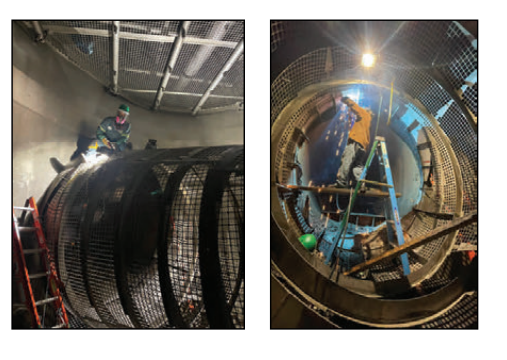
With the widespread implementation of scrubbers on vessels, Oceanwide Repair Group has been called upon by OEMs and vessel owners to perform repairs and modifications involving exotic stainless steel alloys such as SMO254, Duplex, Super Duplex, and 316L stainless steels.
This growing demand has led Oceanwide Repair Group to become fully certified in working with these specialized materials. We are proud to add to our range of certified welding services the capability to provide Class-certified welders holding 6G weld certification across all the aforementioned stainless steel groups.
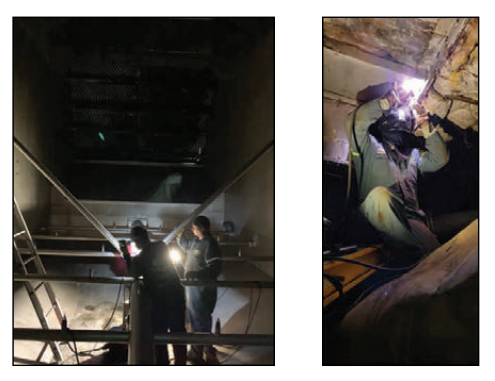
Our repair teams—comprising certified welders, experienced support staff, and all necessary tooling—are prepared to mobilize anywhere in the world to meet your vessel’s repair needs.
With sufficient lead time and planning, we can source all required materials for the repair. Additionally, we offer fabrication of new SMO254 piping systems for the replacement of supply, drain, and overboard piping, complete with a high-durability coating system in collaboration with our coating partners.
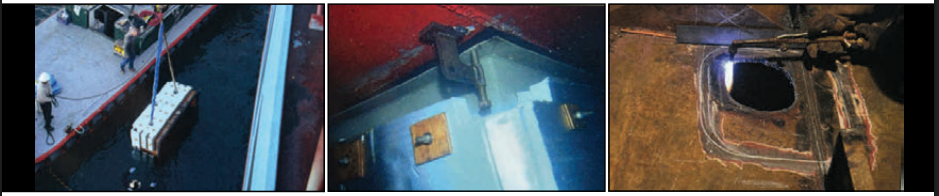
HISTORY OF HULL INSERTS
Throughout its years of operation, Oceanwide Repair has been frequently called upon to address grounding damage and hull fractures occurring below the waterline. Historically, these types of repairs have been classified as “temporary” solutions.
In cases involving fractures, a typical procedure involves a diving company fitting a backing plate over the damaged area, followed by the installation of a cofferdam. Once the cofferdam is in place, the enclosed area is pumped dry to create a workable environment. A certified welder then gouges out the fracture from the inside and welds it into the backing bar. After the welding is complete, divers remove the cofferdam and either grind off the backing bar or fare it into the hull using an epoxy filler.
Over time, this process evolved into a more advanced full-penetration weld repair. The same basic method is used, but instead of simply filling the crack, a full-penetration weld is applied through the fracture, forming a weld crown on the exterior of the hull. After the cofferdam is removed, the weld crown is ground smooth by the diver. Despite the improved technique, this is still classified as a temporary repair.
Underwater hull insert repairs are conducted in a similar fashion, involving the use of a large cofferdam and the welding of a certified steel plate into place by qualified personnel. The welds are then ground smooth and inspected by the U.S. Coast Guard and the attending Class Surveyors. Like other methods mentioned, this repair is also considered temporary and typically results in the issuance of a Condition of Class (COC) by the vessel’s classification society.
Temporary repairs often come with operational constraints, including mandatory underwater inspections within six months. These requirements may prevent the vessel from undergoing UWILD (Underwater Inspection in Lieu of Drydocking) and can disrupt the vessel’s regular dry dock schedule.
HOW THE IDEA CAME ABOUT
Oceanwide Repair set out to develop a service that would eliminate the need for a Condition of Class (COC) to be issued for underwater hull repairs. This advancement allows vessel owners to conduct UWILDs (Underwater Inspections in Lieu of Drydocking) and maintain full-term drydocking intervals without interruption.
To achieve this, Oceanwide partnered with a leading dive and salvage contractor to design a repair method recognized as permanent by all major Classification Societies as well as the U.S. Coast Guard.
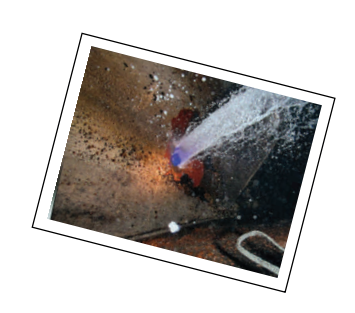
Leveraging its expertise in ceramic tape welding, Oceanwide developed a specialized procedure. A cofferdam is installed over the affected area, and a custom metal track is used to hold the ceramic tape in position. This allows the insert to be fitted and welded with the same precision and quality as a repair performed in dry dock.